Editorial Planning for Scalable Growth: How to Build a 90-Day Content Roadmap
Most content calendars fail for the same reason: they’re built around what’s easy to write, not what the business actually needs. A blog post goes out because it’s Tuesday, not because it moves a customer...
-
0 comments
-
50

Most content calendars fail for the same reason: they’re built around what’s easy to write, not what the business actually needs. A blog post goes out because it’s Tuesday, not because it moves a customer closer to a purchase. The result is a content library that’s busy but directionless — lots of output, little impact.
A 90-day roadmap fixes this. It’s long enough to build momentum and short enough to stay accountable to real results. Here’s how I structure one for the brands I work with.
Step 1: Anchor the Roadmap to Business Goals, Not Topics
Before you touch a content calendar, define what the business needs in the next quarter. Is it more qualified leads at the top of the funnel? Higher conversion on existing traffic? Retention and repeat purchases?
Every piece of content in your 90 days should trace back to one of these goals. If you can’t explain how an article supports revenue, retention, or awareness, it doesn’t belong in the roadmap yet — save it for later or cut it.
Step 2: Map Content to the Buyer Journey, Not Just Keywords
Most teams plan content around keyword volume alone. That’s a mistake. Map your topics against three stages instead:
- Awareness — the reader knows they have a problem but not the solution yet.
- Consideration — they’re comparing options and evaluating fit.
- Decision — they’re ready to buy and need reassurance.
A 90-day roadmap should have a deliberate mix across all three — roughly 40% awareness, 35% consideration, 25% decision — rather than clustering everything at the top of the funnel where it never converts.
Step 3: Break the Quarter Into Three 30-Day Sprints
Trying to plan 90 days in perfect detail upfront is a waste of time — priorities shift. Instead, plan in sprints:
- Days 1–30: Foundation content — cornerstone guides, pillar pages, and evergreen resources that support SEO and can be repurposed later.
- Days 31–60: Supporting and seasonal content — pieces tied to campaigns, product launches, or timely trends that reinforce the foundation pieces.
- Days 61–90: Conversion-focused content — case studies, comparison pages, and bottom-funnel pieces that push warmed-up readers toward a decision.
Each sprint should end with a short review: what performed, what didn’t, and what needs adjusting before the next 30 days.
Step 4: Build One Central Calendar With Four Fixed Fields
A roadmap only works if it’s usable day-to-day. Keep the calendar simple, with four non-negotiable fields for every piece of content:
- Business goal it supports
- Funnel stage it targets
- Primary channel for distribution (blog, email, social, etc.)
- Owner and deadline
Skip anything more complex at first. Overbuilt spreadsheets are one of the top reasons editorial calendars get abandoned by week three.
Step 5: Plan Distribution Before You Plan Creation
Content that isn’t distributed doesn’t exist. For every piece in the roadmap, decide upfront how it will reach an audience: an email send, a social series, a paid boost, or an internal link from a higher-traffic page. If a distribution plan doesn’t already exist for a topic, question whether it belongs on the calendar at all.
A good rule of thumb: for every hour spent creating content, budget at least half an hour planning how it gets seen.
Step 6: Build in a Review Checkpoint at Day 45
Halfway through the quarter, pull performance data — traffic, engagement, conversions — and compare it against the original goals from Step 1. This is the point to kill underperforming topics, double down on what’s working, and adjust the final 45 days accordingly. A roadmap that never gets revisited is just a wish list.
The Bottom Line
A 90-day content roadmap isn’t about filling a calendar — it’s about sequencing content so every piece has a clear job, a clear audience, and a clear path to distribution. Start with the business goal, map the funnel honestly, and build in checkpoints to course-correct. That’s what turns content from a cost center into a growth engine.
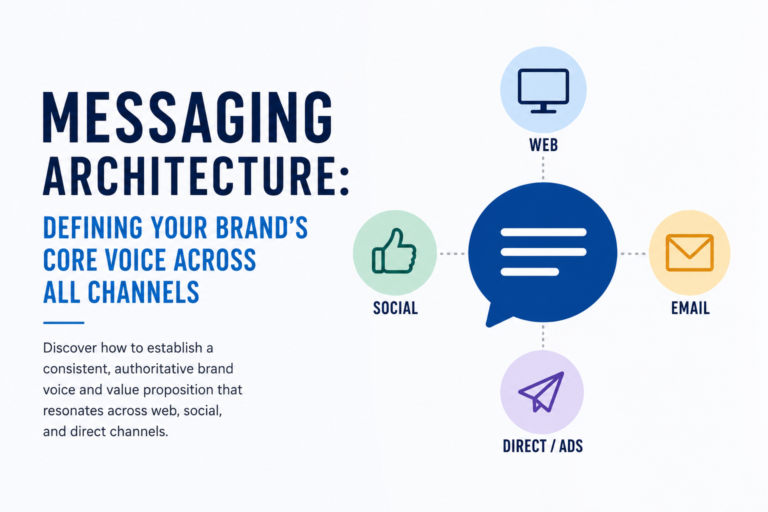
Next in this series: Messaging Architecture — how to define a brand voice consistent enough to carry this roadmap across every channel.



Latest Posts