
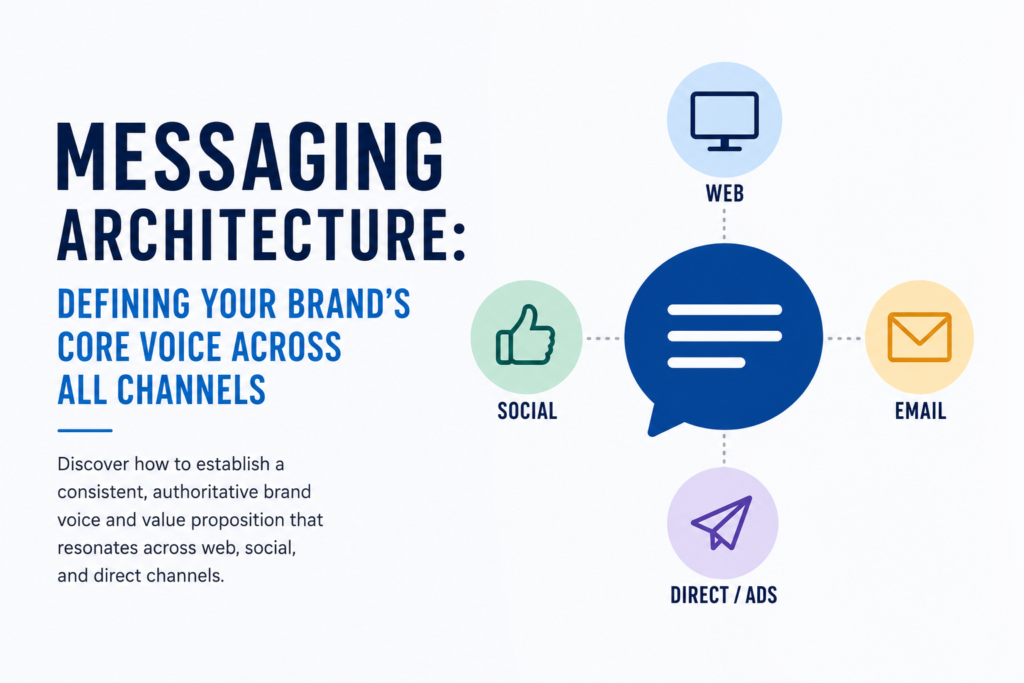
Messaging Architecture: Defining Your Brand’s Core Voice Across All Channels
I’ve audited brands where the website sounds like a Harvard Business Review article, the Instagram sounds like a college roommate, and the sales emails sound like a legal disclaimer. Individually, each piece of content might...
-
0 comments
-
41

I’ve audited brands where the website sounds like a Harvard Business Review article, the Instagram sounds like a college roommate, and the sales emails sound like a legal disclaimer. Individually, each piece of content might be fine. Together, they tell a customer the brand doesn’t know who it is.
That inconsistency isn’t a tone problem — it’s a missing foundation. Messaging architecture is the fix: a documented system that defines how your brand sounds and what it stands for, so every channel pulls from the same source instead of improvising.
Why “Brand Voice” Guidelines Usually Fail
Most brand voice documents are three adjectives on a slide — “friendly, bold, authentic” — with no instruction on what that actually means in a sentence. The result is guidelines nobody can apply consistently, because “friendly” to one writer means casual jokes and to another means warm formality.
A real messaging architecture replaces adjectives with rules: specific word choices, sentence structures, and things the brand will never say. It should be specific enough that two different writers produce copy that sounds like it came from the same person.

The Four Layers of Messaging Architecture
1. Core Value Proposition
This is the single sentence that answers: what do you do, for whom, and why does it matter more than the alternative? It’s not a tagline — it’s the internal compass every other message gets checked against. If a piece of content doesn’t reinforce this proposition in some way, it’s probably off-brand, no matter how well written it is.
2. Brand Personality (Defined Through Contrast)
Instead of listing adjectives, define your voice by what it is and is not. For example: “Confident, not arrogant. Direct, not blunt. Knowledgeable, not academic.” The contrast gives writers a boundary, not just a vibe. This is the difference between a guideline that sounds good in a meeting and one that actually changes how copy gets written.
3. Tone Range by Channel
Voice stays constant — tone flexes. Your brand’s personality shouldn’t change between your website and your Instagram captions, but the tone naturally shifts with context:
- Website/product pages: authoritative and clear, minimal slang.
- Social media: same voice, more conversational rhythm, shorter sentences.
- Email/direct: same voice, more personal, second-person heavy (“you,” not “customers”).
- Customer support: same voice, warmer and more patient, less sales-driven.
Document this as a simple range, not separate personalities. The reader should be able to tell it’s the same brand even as the format changes.
4. Language Rules
This is where architecture becomes usable day-to-day. Define:
- Words to use — specific terms your brand favors (e.g., “clients” not “users,” “build” not “leverage”).
- Words to avoid — corporate jargon, overused buzzwords, or phrases competitors have worn out.
- Sentence rhythm — short and punchy vs. longer and explanatory, and where each applies.
- Grammar and formatting quirks — Oxford comma or not, contractions or not, how headlines are cased.
These rules feel small individually, but they’re what makes copy instantly recognizable as yours, even without a logo attached.
Building It: A Simple Process
- Audit existing content across your website, social, and email to find where the voice is strongest and where it drifts.
- Interview your best copy — pull the highest-performing pieces and identify what they have in common structurally and tonally.
- Draft the four layers above in a single one-page document, not a 20-page brand bible nobody reads.
- Test it against real content — rewrite one existing page using the new architecture and compare it side-by-side with the original.
- Distribute it to every writer, freelancer, and agency touching your content, and make it a required reference in every content brief.
The Bottom Line
A consistent brand voice isn’t about creativity — it’s about discipline. When your value proposition, personality, tone range, and language rules are documented clearly, every channel starts reinforcing the same brand instead of fragmenting it. Customers may not consciously notice consistent messaging, but they absolutely notice its absence.
This closes out the Content Strategy pillar. Next up: E-Commerce UX Optimization — turning that consistent messaging into a website that actually converts.





Latest Posts