The 5-Part Automated Welcome Sequence That Converts Cold Leads
A new subscriber is the warmest a lead will ever be. They just handed over their email address because something about your brand caught their attention — and then most companies waste that moment with...
-
0 comments
-
47

A new subscriber is the warmest a lead will ever be. They just handed over their email address because something about your brand caught their attention — and then most companies waste that moment with a single generic “Welcome! Here’s 10% off” email and nothing else.
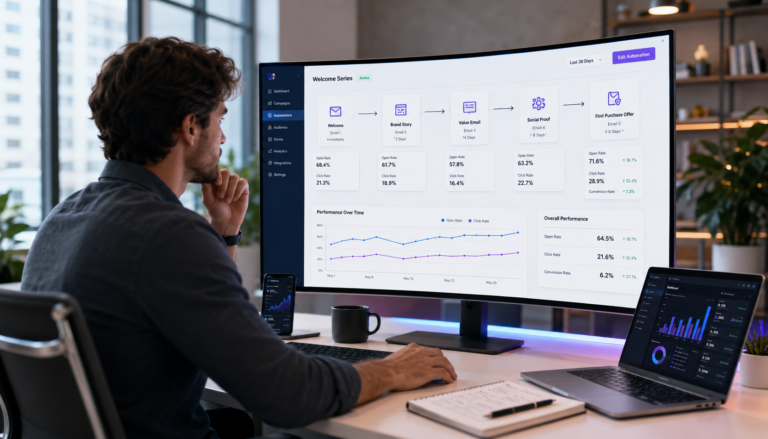
A structured welcome sequence does more work in the first week of a subscriber relationship than months of regular newsletters. Here’s the five-part framework I use to turn that initial interest into a first purchase.
Email 1: The Immediate Welcome (Sent Instantly)
This email needs to land within minutes of signup, while intent is highest. Its job isn’t to sell — it’s to confirm the subscriber made the right choice and set expectations.
- Thank them for joining and briefly reintroduce what the brand does and who it’s for.
- Reinforce the value proposition in one or two sentences — why this brand, specifically.
- If a signup incentive was promised (a discount code, a free guide), deliver it clearly here, not buried in a later email.
Keep this email short. Overloading it with product pitches this early undercuts the trust you’re trying to build.
Email 2: The Brand Story (Sent 1–2 Days Later)
This is where you build emotional connection, not just product awareness. Share the origin story, the problem the brand was built to solve, or the values driving the business.
- Focus on why the brand exists, not just what it sells.
- Include a founder’s voice or behind-the-scenes element if possible — subscribers respond to people, not just logos.
- End with a soft, low-pressure link back to the site (browse the collection, read more), not a hard sales push.
This email builds the trust that later, more direct sales emails will rely on.
Email 3: Social Proof and Credibility (Sent 3–4 Days Later)
By now the subscriber knows what you sell and why the brand exists. This email answers the unspoken question: “Do other people actually trust this?”
- Feature specific testimonials or reviews, ideally with real names and results, not just star ratings.
- Include any relevant press mentions, certifications, or notable customer logos if applicable.
- If you have data points (units sold, years in business, customer count), use them here rather than in the first email, where they’d feel like a sales pitch.
Email 4: Address the Objection (Sent 5–6 Days Later)
Every subscriber has a reason they haven’t purchased yet — price hesitation, uncertainty about fit, or simply not having an urgent need yet. This email should proactively address the most common objection your customers report.
- If it’s price: highlight value, guarantees, or payment flexibility.
- If it’s uncertainty about fit or quality: highlight your return policy, satisfaction guarantee, or a detailed FAQ.
- If it’s lack of urgency: introduce a relevant use case or seasonal reason to act now.
This is the email where you can start being more direct about your product, because trust has already been built in emails 2 and 3.
Email 5: The Conversion Push (Sent 7 Days Later)
The final email in the sequence makes a clear, time-bound ask. This is where urgency and incentive combine to convert subscribers who’ve been warming up all week but haven’t purchased yet.
- Offer a limited-time incentive if one hasn’t already been used (free shipping, bundle discount, or a reminder of the original signup discount with an expiration date).
- Make the CTA singular and specific — one product category, one action, not a generic “shop now.”
- If they still don’t convert here, move them into your regular newsletter cadence rather than continuing to push — repeated hard sells past this point damage trust rather than building it.
Timing and Testing Notes
- Spacing matters as much as content. Sending all five emails too quickly feels like spam; too slowly loses momentum. The 1–7 day cadence above works well for most consumer brands, but test against your own open and click data.
- Segment where possible. If a subscriber joined through a specific product page or quiz, tailor the sequence’s examples and offers to that entry point rather than sending a fully generic version.
- Track sequence-level conversion, not just individual email performance. A weak-performing email 2 might still be doing its job if it’s setting up strong conversion in email 4 or 5.
The Bottom Line
A welcome sequence isn’t a single email with a discount code attached — it’s a structured trust-building process that meets a new subscriber where they are and moves them, step by step, toward a first purchase. Get the sequencing right, and this automation will consistently outperform nearly every other email you send.
Next in this series: Newsletter Monetization — turning your ongoing list into a genuine revenue channel beyond the welcome sequence.




Latest Posts