Customer Lifetime Value Architecture: Building Automated Lifecycle Funnels
Most e-commerce brands spend heavily to acquire a customer, then stop thinking about them the moment the order confirmation email sends. That’s backwards. The most profitable growth lever available to an established store isn’t a...
-
0 comments
-
36

Most e-commerce brands spend heavily to acquire a customer, then stop thinking about them the moment the order confirmation email sends. That’s backwards. The most profitable growth lever available to an established store isn’t a new acquisition channel — it’s getting existing customers to buy again, more often, at a higher value.
Customer Lifetime Value (CLV) architecture is the system that makes this happen automatically, without manually managing every customer relationship. Here’s how to build it.
Why Lifecycle Funnels Matter More as You Scale
Acquiring a new customer typically costs several times more than retaining an existing one. As acquisition costs rise across paid and organic channels, the businesses that stay profitable are the ones extracting more value from each customer relationship over time, not just chasing more first-time buyers.
A lifecycle funnel maps every stage a customer moves through after their first purchase, and automates the right message at each stage — so retention isn’t dependent on someone remembering to send a manual campaign.
Stage 1: The Post-Purchase Window (Days 0–14)
This stage builds confidence in the purchase and sets up the next one.
- Order and shipping updates should feel reassuring, not purely transactional — a brief line reinforcing the value of what they bought reduces buyer’s remorse and return requests.
- A delivery follow-up a few days after expected arrival, checking satisfaction and inviting a review, builds social proof for future customers while signaling you care about the experience, not just the sale.
- Avoid upselling immediately. Pushing another purchase before the first one has even arrived feels tone-deaf and can hurt trust.
Stage 2: The Complementary Upsell Window (Days 14–45)
Once a customer has received and (ideally) used the product, this is the window to introduce genuinely relevant next purchases.
- Cross-sell based on actual product logic, not generic best-sellers — accessories, refills, or products frequently bought alongside their original purchase.
- Frame the offer around the original purchase, referencing what they bought rather than sending a generic promotional email that could go to anyone.
- Time this around realistic usage patterns. A consumable product might warrant an offer sooner; a durable good might need a longer gap before a complementary offer makes sense.
Stage 3: The Replenishment or Repeat-Purchase Window (Variable Timing)
For consumable or subscription-friendly products, this stage is where automation has the highest leverage, because timing can be calculated rather than guessed.
- Base timing on actual consumption data where available (average days between reorders), not an arbitrary fixed schedule.
- Offer a subscribe-and-save option at this stage if it fits the product, converting a one-time buyer into a recurring revenue source.
- For non-consumable products, this stage shifts to seasonal or occasion-based triggers — a relevant new arrival, a seasonal need, or a gift-giving occasion tied to their purchase history.
Stage 4: The Loyalty and Advocacy Window (After Multiple Purchases)
Once a customer has purchased two or more times, they’ve proven meaningfully higher value than a first-time buyer, and the lifecycle goal shifts from conversion to retention and advocacy.
- Introduce loyalty or rewards program benefits if you have one, or early access to new products and sales as a non-discount-based incentive.
- Ask for referrals or reviews at this stage, since repeat customers are your most credible source of social proof and typically your best source of new customer referrals.
- Personalize communication frequency — your highest-value repeat customers often warrant a different (sometimes lighter, more curated) email cadence than one-time buyers still being nurtured toward a second purchase.
Stage 5: The Win-Back Window (Lapsed Customers)
When a customer who previously purchased goes quiet for a defined period (often 60–120 days depending on typical purchase cycle), a distinct win-back sequence should trigger automatically.
- Start softer — a check-in or new arrivals highlight, not immediately a discount, to see if simple re-engagement works first.
- Escalate incentive if needed — if the first touch doesn’t re-engage them, a stronger offer (meaningful discount, free shipping) in a follow-up email often recovers a portion of lapsed customers.
- Set a sunset point. If a lapsed customer doesn’t respond after a full win-back sequence, move them to a reduced-frequency list rather than continuing to email indefinitely — this protects your sender reputation and keeps engagement metrics meaningful.
Mapping It All Into One System
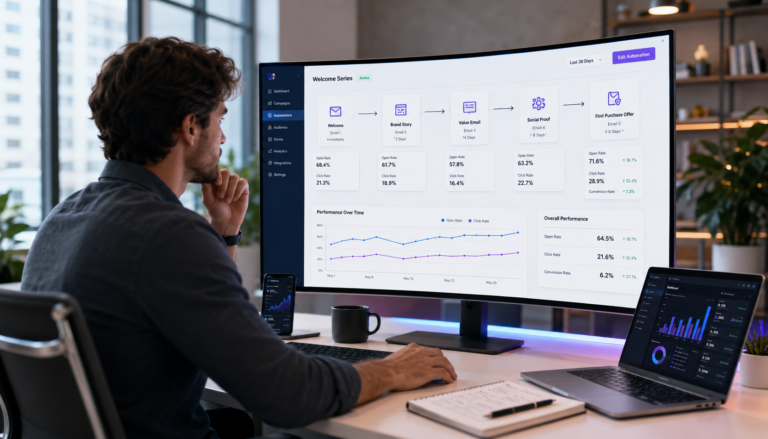
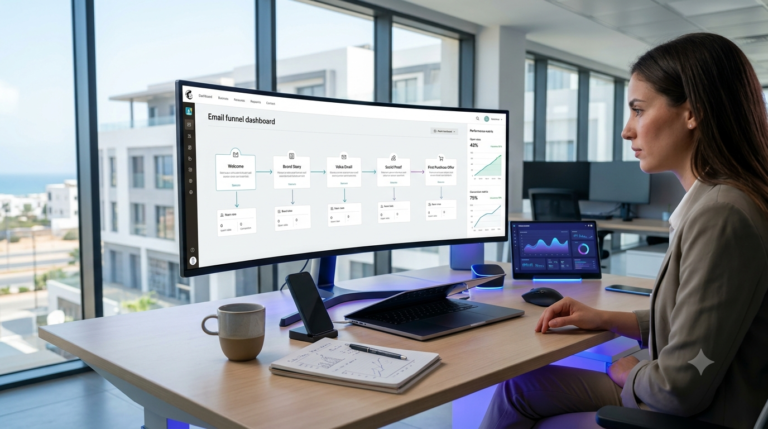
The full architecture should be visualized as a single flowchart: acquisition feeds into the post-purchase window, which branches into upsell and replenishment paths based on product type, which feeds into loyalty for repeat buyers or win-back for those who go quiet. Each transition point should have a clear trigger (time elapsed, purchase event, engagement drop) so the system runs without manual oversight.
Measuring Success: CLV, Not Just Campaign Metrics
The right metric for this entire system isn’t open rate or even single-campaign revenue — it’s average customer lifetime value over a defined period (6, 12, or 24 months), tracked by acquisition channel and product category. If CLV is rising over time as this architecture matures, the lifecycle system is working, even if individual campaign metrics look modest in isolation.
The Bottom Line
Customer lifetime value isn’t something that happens by accident after a good first purchase — it’s engineered through a deliberate sequence of automated touchpoints that meet the customer at each realistic stage of their relationship with the brand. Build the stages once, automate the triggers, and every customer who converts starts contributing far more than the value of that single first order.
This closes out the Email & Funnels pillar. Next up: Data-Driven Marketing — the analytics foundation needed to know whether all of this is actually working.



Latest Posts